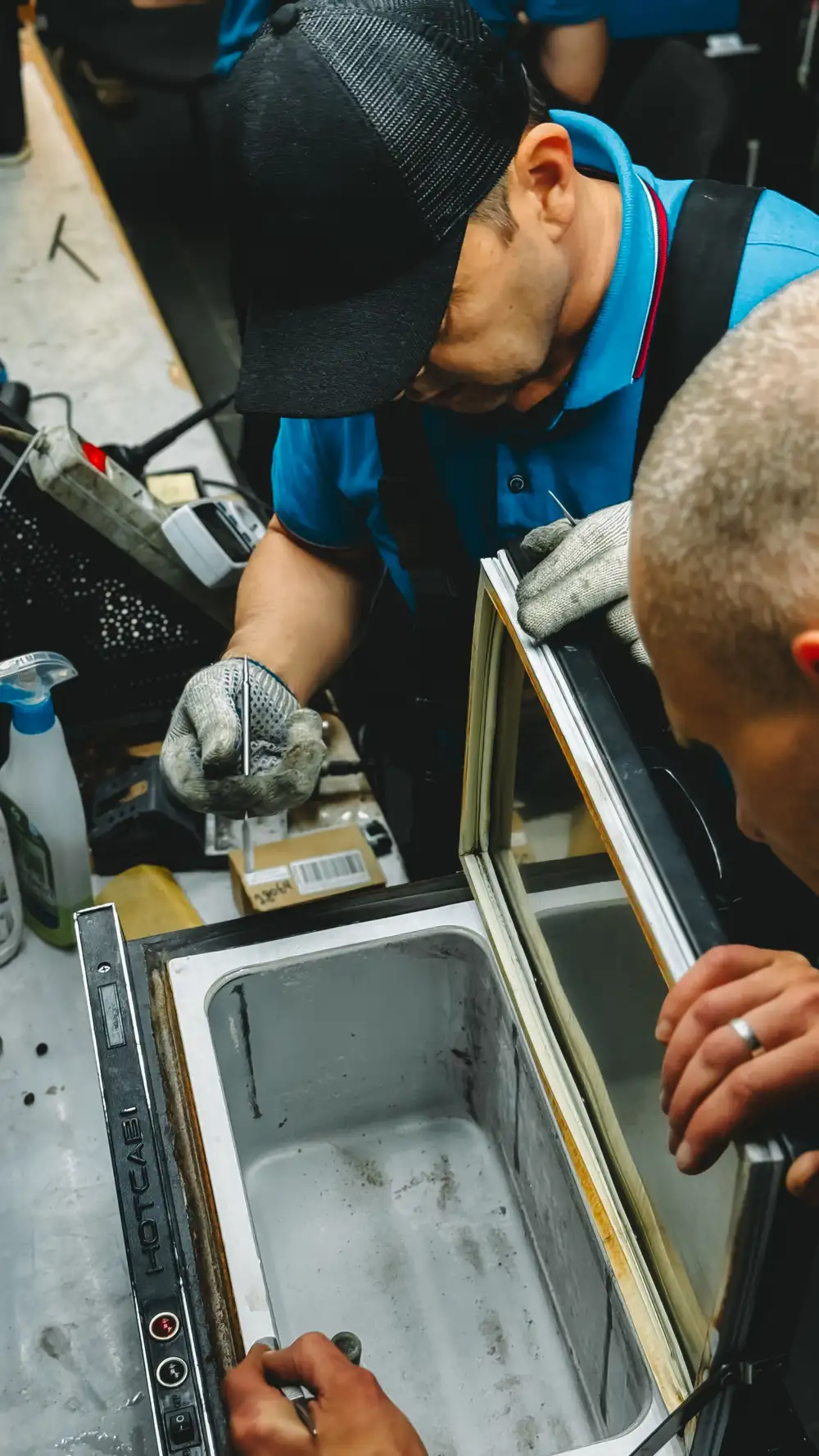
An ice maker that won't fill, won't dispense, or makes hollow or oddly shaped cubes usually traces back to the water-inlet valve, the fill tube, or the ice-maker module itself. We test the water supply, the valve, and the module before recommending a part, so you're not replacing something that wasn't actually broken.

Ice maker problems in built-in refrigerator units and standalone ice machines both come down to a handful of common causes: a blocked or frozen fill tube, a failed water-inlet valve, a stuck ejector arm, or a control module that's stopped triggering the fill cycle. We test the actual water flow and electrical signal to the ice maker rather than assuming the whole unit needs replacing, since in many cases the fix is a single part — the inlet valve or the fill tube — rather than the entire ice-maker assembly.
The same diagnostic path, every visit.
Testing the valve that controls water flow into the ice-maker mold or machine.
Checking for a frozen or blocked fill tube, often caused by freezer temperature that's too warm or too cold.
Testing the control module that triggers the fill, freeze, and harvest cycle.
Checking for a stuck ejector arm or a bin sensor that's incorrectly reporting the bin is full.
An ice maker running constantly to keep up with demand, or a freezer running warmer than it should to compensate for a bad fill tube, can affect food storage temperatures elsewhere in the unit. The sooner an ice-maker fault is diagnosed, the less risk to everything else stored in the freezer compartment.
Ice maker problems are frequently misdiagnosed as "the whole unit is broken" when the actual fault is a single inexpensive part. Testing the water-inlet valve, fill tube, and module individually means you replace only what's actually failed.

Ice makers and standalone ice machines both use a water-inlet valve, a fill mechanism, and a control module, so the diagnostic approach is similar even though the hardware differs. Businesses running commercial ice machines and homeowners with a built-in refrigerator ice maker both benefit from the same principle: confirm which specific component failed before replacing anything. A frozen fill tube is often mistaken for a bad module, and a bad bin sensor is often mistaken for a full bin, so testing each part individually avoids paying for parts that were never actually broken.
Straight answers — no clicking around.
Call Portland Refrigerator Repair to schedule a same-day or next-day ice-maker diagnostic visit.
(888) 555-0123